Table of Contents
9 Tips for Making Partner Practice Work in Your Math Classroom
Can’t get kids to work in partners without fighting?
I’ve got your back.
If you’re new here, you might not know about my obsession with Partner Practice. Stick around long enough and you’ll notice I talk about it ALL. THE. TIME.
Partner Practice is a magical 5–7 minute block between direct instruction and independent practice. Students sit side by side, talk through their learning, and build confidence before working on their own.
Meanwhile, you’re circulating the room, listening carefully, and spotting misconceptions so you can nip them in the bud before they turn into bad habits.
So many of you have reached out to me with recurring challenges during partner work. That motivated me to dive deeper and create this list of 9 quick tips to make Partner Practice run smoothly in your classroom.
What Is Partner Practice (and Why I’m Obsessed)
Partner Practice happens after direct instruction but before independent practice.
It gives students a chance to:
- Talk through new concepts
- Test their understanding
- Learn from peers
- Gain confidence before working independently
It also gives teachers something incredibly valuable:
Real-time insight into student thinking.
Instead of discovering misconceptions when you’re grading after school, you catch them in the moment. When you can still do something about it!
That’s why I’m such a believer in this routine.
Why Partner Practice Matters in Math Instruction
Math learning isn’t just about getting the right answer — it’s about explaining the thinking behind it.
Partner Practice creates space for:
- Mathematical conversations
- Academic vocabulary use
- Reasoning and justification
- Confidence building
When done well, it transforms math from a silent activity into an active learning experience.
But like any classroom routine, Partner Practice only works when students know exactly what to do.
That’s where these nine tips come in.
9 Tips for Making Partner Practice Work
Tip #1: Make Strategic Pairs
Divide your roster into quartiles based on your latest assessment.
Then pair:
- Q1 with Q3
- Q2 with Q4
After that, adjust for personality.
Try to:
- Balance introverts with extroverts
- Avoid pairings that might get too silly
- Create partnerships where students can support each other
Thoughtful pairing makes everything else easier.
Tip #2: Teach It Explicitly
Partner Practice is not something students automatically know how to do.
Like any classroom procedure, it must be:
- Modeled
- Practiced
- Reinforced
Show students exactly:
- How to sit
- How to talk
- How to listen
- How to take turns
Never assume they’ll figure it out on their own.
Tip #3: Start with Easy Content
The first time you introduce Partner Practice, keep the math simple.
Choose a topic that students already understand so they can focus on:
The routine — not the difficulty of the math.
Once the structure feels comfortable, then increase the complexity.
This builds confidence and reduces frustration.
Tip #4: Set the Stage
Physical positioning matters more than you might think.
Have students:
- Shift their papers closer together
- Angle their chairs toward one another
- Sit up tall and face their partner
This body language naturally encourages collaboration.
Small physical adjustments lead to big behavioral improvements.
Tip #5: Don’t Answer Questions (Yet!)
This one is tough — but powerful.
When students ask for help, resist the urge to jump in immediately.
Instead, say:
“Ask your partner! I know you can figure this out together. I’ll take questions in a few minutes.”
A little productive struggle is where the real learning happens.
Students build independence when they rely on each other first.
Tip #6: Circulate with a Clipboard
While students are working, walk the room with purpose.
Jot down:
- Common mistakes
- Confusing steps
- Misunderstandings
Use these notes to guide your debrief when you bring the class back together.
This turns Partner Practice into a powerful formative assessment.
Tip #7: Say It, Then Write It
Nothing should go on paper until it’s been said out loud and agreed upon.
This simple rule:
- Encourages discussion
- Strengthens reasoning
- Slows down rushed thinking
When students verbalize first, their written work becomes more accurate.
Tip #8: One Paper, One Pencil (If Needed)
If a pair isn’t talking, simplify the setup.
Remove one set of materials so the pair shares:
- One paper
- One pencil
Have students alternate being the scribe.
This forces communication and shared responsibility.
They might fuss at you, but it works!
Tip #9: Change Seating Often
I shuffle my seating chart every two weeks.
It helps:
- Reduce complaints
- Keep partnerships fresh
- Discover powerful learning combinations
And if students complain about their partner, remind them it’s just for a short period of time!
Sometimes I’ll intentionally keep a strong pairing together longer and then I quietly tell the stronger student:
“You’re staying here because you’re such an amazing tutor.”
That little moment builds pride and leadership.
Final Thoughts on Making Partner Practice Successful
Partner Practice isn’t just another routine — it’s a powerful bridge between teaching and independent learning.
When students talk through their thinking, they deepen understanding, catch mistakes early, and build confidence that carries into independent work.
And when teachers circulate intentionally, they gain valuable insight into student thinking that can shape instruction in meaningful ways.
If you’ve struggled to make partner work run smoothly, try implementing just one or two of these tips first. Small changes can make a big difference.
Math love,
Sally
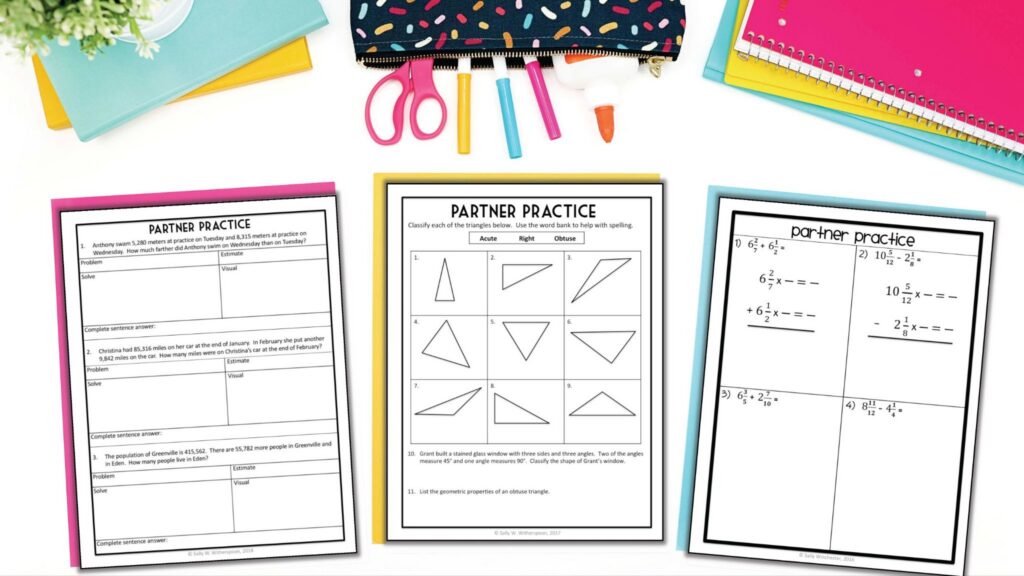
P.S. Did you know that every single lesson in my store includes Partner Practice? (I told you I was obsessed!)
Click here to explore my Freebie Library — you’ll find some great resources you can use right away.
FAQs About Partner Practice in Math Class
How long should Partner Practice last?
Most effective Partner Practice sessions last 5–7 minutes. This gives students enough time to talk through their thinking without losing focus.
What if students argue during Partner Practice?
Conflicts usually happen when expectations aren’t clear. Spend time modeling how to disagree respectfully and reinforcing conversation norms regularly.
Should partners be ability-based or mixed ability?
Mixed-ability pairing often works best. Pairing students strategically allows stronger students to model thinking while supporting developing learners.
What do I do if students won’t talk to each other?
Try the One Paper, One Pencil strategy. Removing duplicate materials encourages students to collaborate and communicate.
How often should partners change?
Changing partners every 2–3 weeks keeps routines fresh, prevents boredom, and helps students learn to collaborate with different classmates. It’s easier to calm a disagreement if you remind them it’s only for a short period of time!