
Table of Contents
Teaching Mixed Numbers & Improper Fractions Without Losing Your Mind!
Table of Contents
- Why Fractions Greater Than One Cause So Much Confusion
- Tip #1: Always Start with a Model
- Tip #2: Clarify What the Denominator Really Means
- Tip #3: Converting Mixed Numbers to Improper Fractions — CRANK IT UP!
- Tip #4: Converting Improper Fractions to Mixed Numbers — Get Out Those Crayons
- Tip #5: Use Word Problems to Build Real Understanding
- Why This Topic Deserves More Instructional Time
- FAQs About Teaching Mixed Numbers and Improper Fractions
Making Sense of Fractions Greater Than One
Teaching Mixed Numbers & Improper Fractions Without Losing Your Mind!
Are mixed numbers and improper fractions causing nonstop drama in your classroom?
The second the numerator becomes greater than the denominator, total chaos ensues, right?
Students freeze. Papers fill with crossed-out work. Someone inevitably asks, “Wait… why is the big number on top?”
If this sounds familiar, you’re not alone. Fractions greater than one whole are one of the most misunderstood fraction concepts in upper elementary math. But with the right visuals and consistent routines, students can move from confusion to confidence.
Here are some simple, classroom-tested tips to help these fractions greater than one whole finally stick.

Tip #1: Always Start with a Model
If students can use a model to write both the improper fraction and the mixed number, they’ll see that both represent the same quantity.
They’ll also understand why the denominator stays the same when we convert between forms or add & subtract.
It’s the same picture — we’re just counting pieces in a different way.
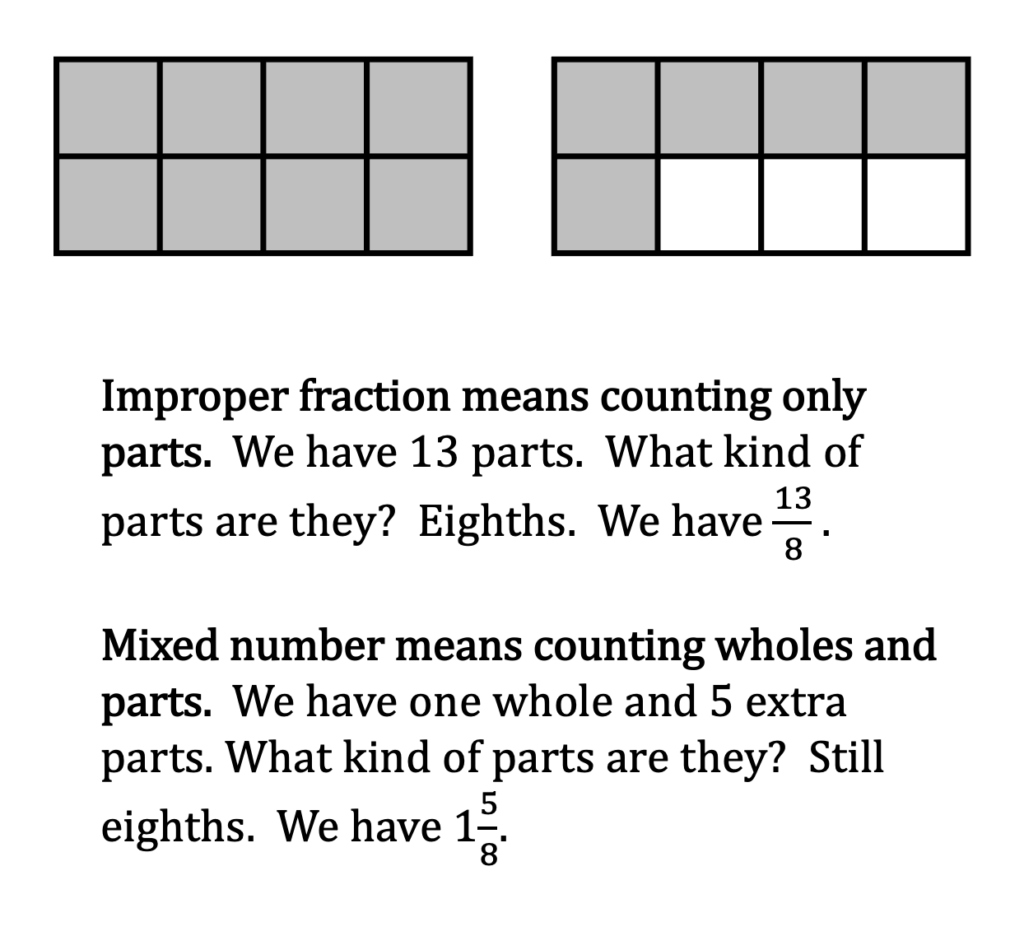
Same picture. Same amount. Different way to write it.
This visual connection is the foundation for everything that comes next.
Tip #2: The Denominator Represents Pieces in ONE Whole
This is one of the biggest misconceptions students have.
Many students think the denominator represents the total number of pieces in all the wholes combined.
So if they see 3 pizzas with 6 slices each, they might say the denominator is 18.
👉 Instead, remind students:
The denominator tells how many pieces are in ONE whole — not all of them combined.
A simple fix:
- Have students circle one pizza
- Count the slices in that one pizza
- Write 6 as the denominator
- Then move on to counting the rest
This small step clears up huge misunderstandings.

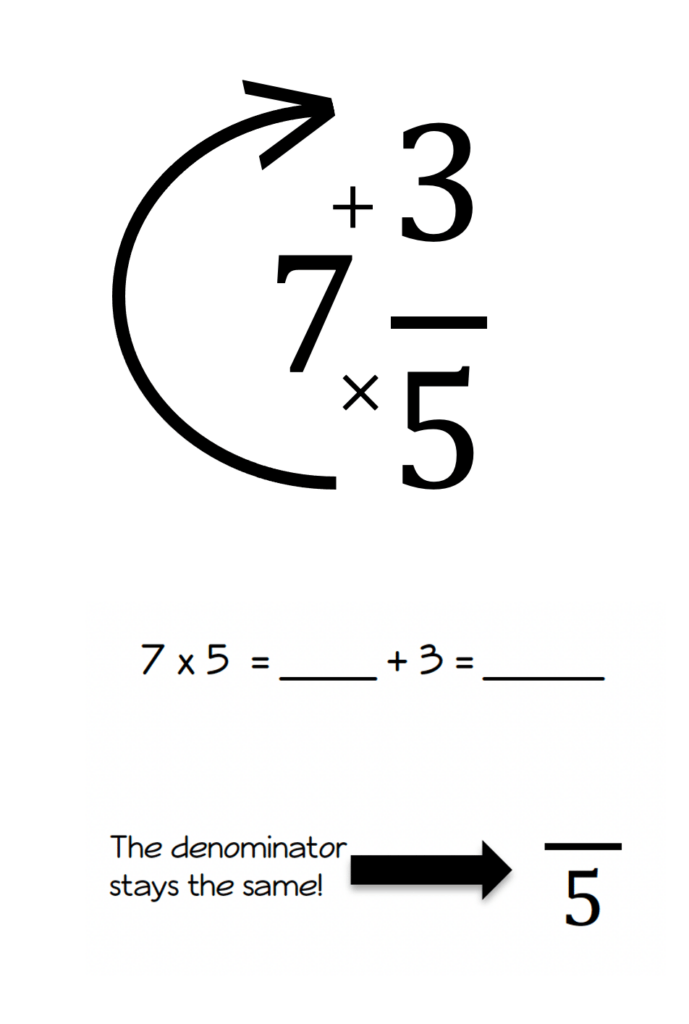
Tip #3: Going from Mixed Number to Improper Fraction? CRANK IT UP!
This is where routines matter.
Draw an arrow:
- From the denominator
- Around the whole number
- To the numerator
Then write:
- Multiplication sign
- Addition sign
This visual cue helps students remember the process every single time.
Instead of memorizing random steps, students follow a predictable pattern they can trust.
Tip #4: Going from Improper Fraction to Mixed Number? Get Out Those Crayons!
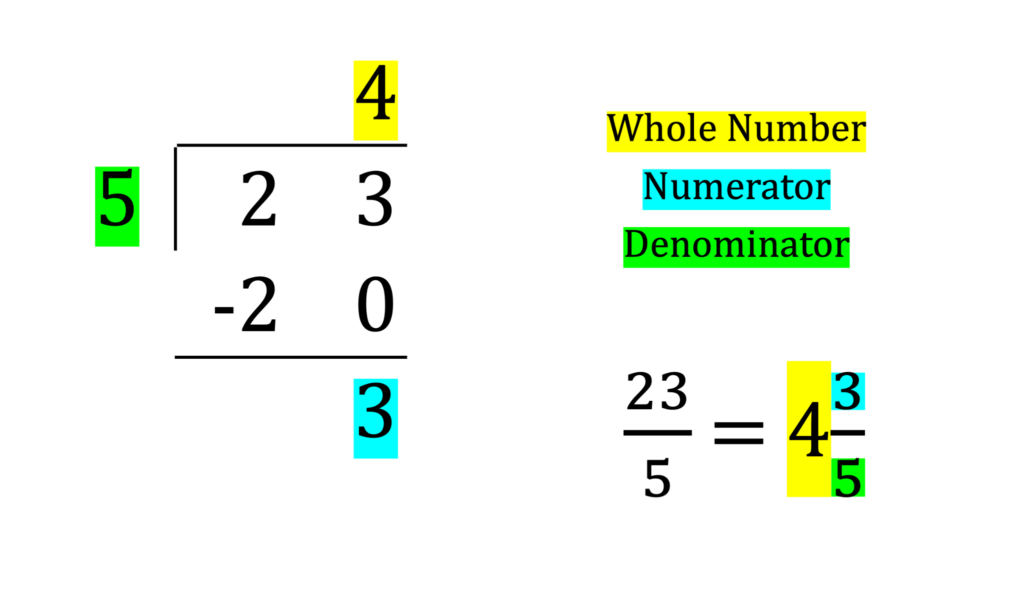
Color coding is incredibly powerful here.
Use consistent colors to show:
- Dividend (numerator)
- Divisor (denominator)
- Quotient (whole number)
- Remainder (new numerator)
Pair colors with precise math language, and suddenly long division starts making visual sense.
Tip #5: Use Word Problems to Build Real Understanding
Any time you see a mixed number in a word problem…
Live in the story with students.
Don’t just solve it — visualize it.
For example:
She studied for 2 1/2 hours
That means:
- 2 full hours
- Half of another hour
He ran 5 2/3 miles
That means:
- 5 full miles
- Almost ran a sixth mile
You have 6 1/8 pizzas
That means:
- 6 full pizzas
- One extra slice
- Is it big? No — it’s small, because it’s just an eighth.
These moments turn fractions into real experiences — and that’s when understanding clicks.
This is one of those topics that doesn’t get nearly enough attention, and because of that, so many students stay on the struggle bus for years.
When students don’t fully understand mixed numbers and improper fractions:
- Fraction operations become harder
- Decimal connections weaken
- Algebra readiness suffers
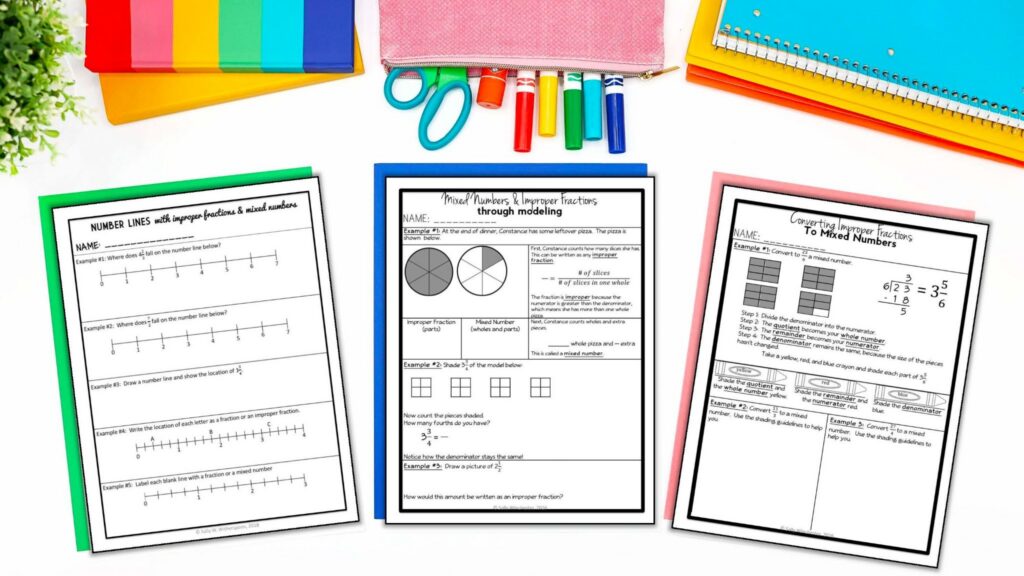
To help fix that, I’ve created a 4-day mini unit devoted entirely to Fractions Greater Than One Whole.
It focuses on models, number lines, and helping students truly understand what it means to be a mixed number or an improper fraction.
👉 Grab the Fractions Greater Than One Whole Bundle here:
Help your students finally move from confusion to confidence — and make fraction lessons drama-free!
Math love,
Sally
FAQs About Teaching Mixed Numbers and Improper Fractions
Why do students struggle with improper fractions?
Most students struggle because they don’t understand that fractions can represent amounts greater than one whole. Without visual models, improper fractions feel like rule-breaking math instead of logical extensions of earlier fraction work.
Should I teach mixed numbers or improper fractions first?
Start with models showing quantities greater than one, then introduce both mixed numbers and improper fractions together. This helps students understand they represent the same value.
What is the best model for teaching fractions greater than one?
With models, the more variety the better. However, avoid mixed numbers on a number line until students are really getting the hang of it. Kids need to be able to see where one whole ends and another one begins. This is tricky on a number line. In my 4-day unit, number lines aren’t introduced until the last day!
Using multiple models strengthens conceptual understanding.
How long should I spend teaching improper fractions and mixed numbers?
Most students benefit from at least 3–5 focused days of instruction that includes modeling, converting, and applying fractions in real-world problems.
How can I help students remember how to convert mixed numbers to improper fractions?
Use consistent visual routines — like drawing arrows and labeling multiplication and addition steps — instead of relying on memorization alone.
Visual patterns stick far longer than rules.